BMW Wheel Spacers.
The complete guide.
Everything you need: fitments, recommended sizes, safety facts, and UK legal requirements — for every performance BMW from E30 to G90.

BMW Wheel Spacers
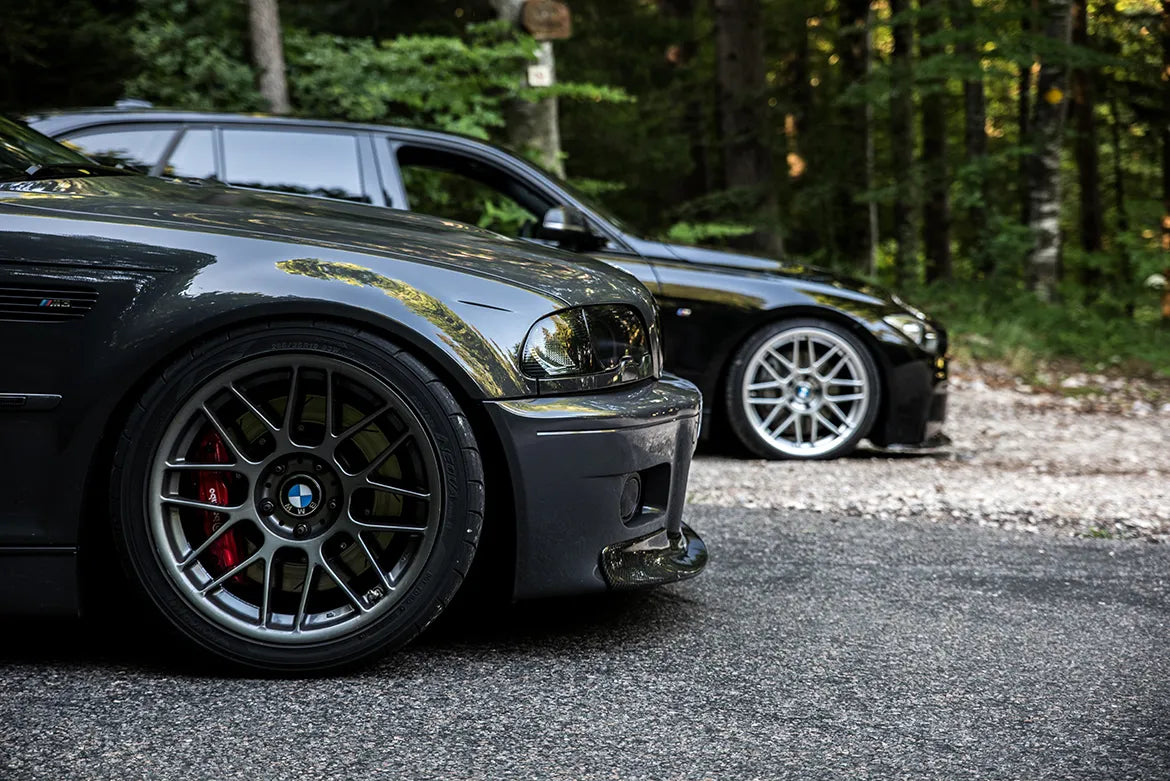
BMW owners love wheel spacers for good reason. They transform the stance, improve handling, and give that aggressive flush-wheel look that makes every BMW look more purposeful.
The key to success lies in choosing hubcentric, UK-made spacers that match BMW's precise engineering standards. Cheap imports create vibration, safety risks, and MOT failures that quality spacers avoid completely.
This guide covers everything you need: BMW bolt pattern and PCD by generation, recommended sizes, safety facts, and UK legal requirements. By the end, you'll know exactly which BMW wheel spacers suit your car and driving style.
Performance BMW Wheel Spacer Fitment Table
Below is a table that will show you the exact fitment you need for your model and year — covering both BMW PCD (5×120 and 5×112) and BMW bolt pattern (M12×1.5 and M14×1.25) across every generation.
5×120 PCD 72.6mm Bore Models
| Model | Chassis | Years | PCD | Centre Bore | Bolt Thread | Notes | Buy |
|---|---|---|---|---|---|---|---|
| BMW 3 Series | E46 | 1998–2006 | 5×120 | 72.6mm | M12×1.5 | 316i–330i, standard trims | Buy → |
| BMW 3 Series | E90 / E91 / E92 / E93 | 2005–2013 | 5×120 | 72.6mm | M12×1.5 | 318i–335i, standard trims | Buy → |
| BMW 5 Series | E60 / E61 | 2003–2010 | 5×120 | 72.6mm | M12×1.5 | 520i–550i, standard trims | Buy → |
| BMW 3 Series | F30 / F31 | 2012–2019 | 5×120 | 72.6mm | M14×1.25 | 316d–340i, standard trims (Saloon & Touring) | Buy → |
| BMW 5 Series | F10 / F11 | 2010–2017 | 5×120 | 72.6mm | M14×1.25 | 520d–550i, standard trims | Buy → |
| BMW 4 Series | F32 / F33 / F36 | 2013–2020 | 5×120 | 72.6mm | M14×1.25 | 420i–435i, standard trims | Buy → |
| BMW 1 Series | F20 / F21 | 2011–2019 | 5×120 | 72.6mm | M14×1.25 | 116i–125i, standard trims | Buy → |
| BMW 1 Series | F20 / F21 | 2016–2019 | 5×120 | 72.6mm | M14×1.25 | M140i | Buy → |
| BMW M2 | F87 | 2016–2021 | 5×120 | 72.6mm | M14×1.25 | M2, M2 Competition, M2 CS | Buy → |
| BMW M3 | E30 | 1986–1992 | 5×120 | 72.6mm | M12×1.5 | Original M3 | Buy → |
| BMW M3 | E36 | 1992–1999 | 5×120 | 72.6mm | M12×1.5 | Coupé / Saloon | Buy → |
| BMW M3 | E46 | 2000–2006 | 5×120 | 72.6mm | M12×1.5 | Including CSL | Buy → |
| BMW M3 | E90 / E92 / E93 | 2007–2013 | 5×120 | 72.6mm | M12×1.5 | V8 S65 engine | Buy → |
| BMW M3 | F80 | 2014–2018 | 5×120 | 72.6mm | M14×1.25 | All F80 M3 variants | Buy → |
| BMW M4 | F82 / F83 | 2014–2020 | 5×120 | 72.6mm | M14×1.25 | Coupé / Convertible | Buy → |
| BMW M5 | E60 / E61 | 2005–2010 | 5×120 | 72.6mm | M12×1.5 | V10 S85 engine | Buy → |
| BMW M5 | F10 | 2011–2016 | 5×120 | 72.6mm | M14×1.25 | M5 & Competition | Buy → |
| BMW M6 | E63 / E64 | 2005–2011 | 5×120 | 72.6mm | M12×1.5 | Coupé & Convertible | Buy → |
| BMW M6 | F06 / F12 / F13 | 2012–2018 | 5×120 | 72.6mm | M14×1.25 | All body styles | Buy → |
| BMW Z3 M | E36/7 / E36/8 | 1997–2002 | 5×120 | 72.6mm | M12×1.5 | M Roadster & Coupé | Buy → |
| BMW Z4 M | E85 / E86 | 2006–2008 | 5×120 | 72.6mm | M12×1.5 | M Roadster & Coupé | Buy → |
The E39 5 Series (including E39 M5) and the E70/F15 generation X5 use a 74.1mm centre bore — different from the 72.6mm bore of our standard 5×120 hubcentric spacer. These models have been deliberately left out of the fitment table above rather than pointed at a product that wouldn't seat correctly. If you own one of these and are looking for spacers, please get in touch directly — this is a genuine SKU gap worth addressing rather than a fitment we can currently ship correctly off the shelf.
5×112 PCD 66.6mm Bore Models
| Model | Chassis | Years | PCD | Centre Bore | Bolt Thread | Notes | Buy |
|---|---|---|---|---|---|---|---|
| BMW M2 | G87 | 2023–present | 5×112 | 66.6mm | M14×1.25 | G87 M2 | Buy → |
| BMW M3 | G80 / G81 | 2020–present | 5×112 | 66.6mm | M14×1.25 | M3 & Touring | Buy → |
| BMW M4 | G82 / G83 | 2021–present | 5×112 | 66.6mm | M14×1.25 | Coupé & Convertible | Buy → |
| BMW 1 Series | F40 | 2019–present | 5×112 | 66.6mm | M14×1.25 | 118i, 120i, M135i | Buy → |
| BMW 2 Series | F44 | 2020–present | 5×112 | 66.6mm | M14×1.25 | Gran Coupé | Buy → |
| BMW 2 Series | G42 | 2021–present | 5×112 | 66.6mm | M14×1.25 | 220i, M240i xDrive | Buy → |
| BMW 3 Series | G20 / G21 | 2019–present | 5×112 | 66.6mm | M14×1.25 | 318d, 330i, M340i | Buy → |
| BMW 4 Series | G22 / G23 / G26 | 2020–present | 5×112 | 66.6mm | M14×1.25 | 420d, 430i, M440i, M4 | Buy → |
| BMW 5 Series | G30 / G31 | 2017–2023 | 5×112 | 66.6mm | M14×1.25 | 520d, 530e, M550i | Buy → |
| BMW 5 Series | G60 / G61 | 2023–present | 5×112 | 66.6mm | M14×1.25 | Latest G-series models | Buy → |
| BMW M5 | F90 | 2017–2023 | 5×112 | 66.6mm | M14×1.25 | M5 & Competition | Buy → |
| BMW M5 | G90 | 2024–present | 5×112 | 66.6mm | M14×1.25 | Hybrid M5 | Buy → |
| BMW 7 Series | G11 / G12 | 2015–2022 | 5×112 | 66.6mm | M14×1.25 | Luxury models | Buy → |
| BMW 8 Series | G14 / G15 / G16 | 2018–present | 5×112 | 66.6mm | M14×1.25 | 840i, M850i, M8 | Buy → |
| BMW Z4 | G29 | 2019–present | 5×112 | 66.6mm | M14×1.25 | All models | Buy → |
| BMW X3 | G01 | 2017–present | 5×112 | 66.6mm | M14×1.25 | X3 & X3M | Buy → |
| BMW X4 | G02 | 2018–present | 5×112 | 66.6mm | M14×1.25 | X4 & X4M | Buy → |
| BMW X5 | G05 | 2019–present | 5×112 | 66.6mm | M14×1.25 | 40i, 40d, X5M | Buy → |
| BMW X6 | G06 | 2020–present | 5×112 | 66.6mm | M14×1.25 | 40i, 40d, X6M | Buy → |
| BMW X7 | G07 | 2019–present | 5×112 | 66.6mm | M14×1.25 | xDrive40d, M50i, Alpina XB7 | Buy → |
Torque Specs
| Model Range | Chassis | Bolt Thread | Torque Spec | Notes |
|---|---|---|---|---|
| Modern BMW Models | F-Series / G-Series | M14×1.25 | 140 Nm (103 lb-ft) | Standard torque for most 2010+ BMW models including M cars and X-series |
| BMW M2 / M3 / M4 | F80, F82, F87, G80, G82, G87 | M14×1.25 | 140 Nm | High-performance hubs; same spec as standard F/G-series |
| BMW X Models | X1–X7 (F & G Series) | M14×1.25 | 140 Nm | Including X3M, X4M, X5M, X6M, XB7 |
| Older BMW Models | E-Series (E36, E46, E90 etc.) | M12×1.5 | 120 Nm (88 lb-ft) | Standard for most BMWs before ~2010 |
| BMW Z Models | Z3, Z4 (E36/7, E85, E86) | M12×1.5 | 120 Nm | Matches standard E-series torque |
| Always re-torque wheel bolts after 50–100 miles. Use dry torque only (no lubrication). Do not use an impact gun for final tightening. | ||||
Why Choose Wheel Spacers for BMW?
BMW designs create a conservative wheel-to-arch relationship from the factory. Spacers correct this, giving you the aggressive stance that makes people look twice in car parks.
Improved stability and handling come as welcome bonuses. A wider track reduces body roll in corners and increases grip during spirited driving. Many BMW owners notice sharper turn-in and better high-speed stability after installing spacers.
Brake clearance matters more as you upgrade components. M Performance calipers, Brembo big brake kits, and other aftermarket upgrades often need extra clearance that spacers provide without changing wheels.
Offset correction becomes important with aftermarket wheels. Many replicas and aftermarket options have different offsets than OEM wheels. Spacers let you achieve proper fitment without expensive wheel changes.
BMW Wheel Spacer Fitments Explained
Most BMWs from the 2000s through early 2010s share the same bolt pattern: 5×120 PCD with 72.6mm centre bore. This applies to 1 Series, 3 Series, 5 Series, 7 Series, and X Series models.
However, newer G-series BMWs (2019+) switched to 5×112 PCD. This creates some overlap with Audi and VW fitments, which simplifies parts availability but requires careful checking of your specific model year.
The hubcentric lip height remains consistent at 11mm across most BMW applications. This measurement affects how spacers sit on the hub and determines the minimum spacer thickness for proper fitment.
Always verify your specific model's fitment before ordering. While most BMWs follow these patterns, a small number of models — including the E39 5 Series and the E70/F15 generation X5 — use a different 74.1mm centre bore and aren't currently covered by our standard fitment range. If that's your car, please contact us directly rather than ordering against the table above.
Common BMW Wheel Spacer Mistakes
Every one of these mistakes is completely avoidable. By choosing vehicle-specific hubcentric wheel spacers, using the correct extended bolts and following proper installation procedures, BMW wheel spacers are a safe, reliable modification used by thousands of enthusiasts across the UK.
What's in a Brightstone BMW Wheel Spacer Kit
A wheel spacer kit is more than just two (or four) discs of aluminium. Every Brightstone BMW wheel spacer kit includes everything needed for a correct, safe installation — nothing to source separately.
The spec card confirms your exact PCD, centre bore and bolt torque figure — so you have the correct re-torque value to hand for the 50-100 mile check without needing to look it up. Bolts are matched to your specific spacer thickness, calculated using the same OEM-length-plus-spacer-thickness method covered earlier in this guide, so thread engagement is correct straight out of the box.
What Does Hubcentric Actually Mean?
A hubcentric wheel spacer is machined with a centre bore that matches your BMW's hub exactly — so the hub itself carries the wheel's weight, just as it does without a spacer fitted. A non-hubcentric (or "universal") spacer has an oversized bore and relies entirely on the wheel bolts to hold the wheel centred, which is a fundamentally different — and weaker — load path.
| Hubcentric | Non-hubcentric (universal) |
|---|---|
| Bore matched exactly to BMW hub diameter | Oversized bore fits multiple vehicles |
| Hub carries the load, as standard | Wheel bolts alone carry the load |
| No vibration from off-centre mounting | Higher risk of vibration and wobble |
| Vehicle-specific, correct first time | Generic, requires manual centring |
This is why every Brightstone BMW wheel spacer is machined to a specific model's centre bore rather than sold as a universal fit — it's the same principle that makes OEM wheel mounting safe in the first place, simply extended outward by the spacer's thickness.
Wheel Spacers vs Wheel Adapters — What's the Difference?
These terms get used interchangeably, but they solve different problems. A wheel spacer keeps the same bolt pattern as your BMW and simply pushes the wheel further out — used for stance, brake clearance, or correcting offset on wheels that already match your PCD.
A wheel adapter changes the bolt pattern entirely — for example, letting you fit a 5×112 wheel to an older 5×120 BMW, or run wheels designed for a completely different make. Adapters are thicker by necessity, since they need to accommodate a different stud/bolt layout on each face.
If your wheels already fit your BMW's bolt pattern and you just want a wider stance or extra clearance, you need a spacer — the products on this page. If you're trying to fit wheels designed for a different bolt pattern, you need an adapter instead — see our hub adapter range here.
Wheel Spacers for BMW X3, X5, X6 and X7
BMW's X-series SUVs carry significantly more weight than saloon and coupé models, and that changes what matters in a spacer. Load rating, not just fitment, becomes a real consideration — an X5 or X7 puts far more sustained force through each spacer and bolt than an equivalent 3 Series.
All Brightstone X-series spacers are machined from the same 6082-T6 billet aluminium as our passenger car range, sized and rated with this higher load in mind rather than simply scaled down from a lighter application. G-series X3, X4, X5, X6 and X7 models share the 5×112, 66.6mm bore fitment with other G-series BMWs, listed in the table above.
Earlier X5/X6 generations (E70, E71, F15, F16) use the older 74.1mm centre bore rather than the standard 72.6mm — one of the fitments currently excluded from our range, noted earlier in this guide.
Recommended Spacer Sizes for BMW
BMW 3 Series wheel spacers work best in the 12–15mm range for most applications. This thickness provides the ideal balance between improved stance and maintained handling characteristics without creating clearance issues.
Subtle improvements come from 5–10mm spacers. These provide slight stance enhancement and minor brake clearance gains without dramatically changing the car's character. Perfect for owners who want improvement without attention.
The 12–15mm range represents the sweet spot for most BMW owners. Wheels sit closer to the arches without looking excessive, handling improves noticeably, and brake clearance increases significantly.
Aggressive setups use 18–20mm spacers for that flush wheel look. This creates wider track and more dramatic stance but requires careful checking of suspension clearances and may affect ride quality slightly.
Extreme applications go beyond 25mm thickness. These work well for show cars or when adapting wheels with very different offsets. However, they change handling characteristics more dramatically and need careful consideration.
BMW F10 wheel spacers commonly run 15–20mm to fill the larger wheel arches properly. The 5 Series has more space to fill, and this range achieves the proportional look that smaller spacers can't match.
E92 M3 owners often choose 12mm front and 15mm rear for track balance. This setup maintains the factory stagger while improving stance and providing clearance for upgraded brake components.
Bolt and Hardware Requirements for BMW Spacers
Most BMWs use M12×1.5 bolts with conical seats. The thread pitch and seat type are specific to BMW and can't be substituted with generic hardware without risking safety.
G-series models often use M14×1.25 bolts instead. This larger diameter provides increased clamping force but requires different extended bolts when adding spacers.
BMW extended wheel bolts — how to size them
Extended bolt length calculation remains simple: OEM bolt length plus spacer thickness equals required length. For example, 25mm OEM bolts with 15mm spacers need 40mm extended bolts minimum.
Seat type matching prevents wheel damage and improves safety. BMW's conical seats distribute clamping force evenly across the wheel's mounting surface. Ball seats or incorrect angles can cause cracking or loosening.
Brightstone spacer kits include correct extended bolts matched to your specific BMW model. This eliminates guesswork and prevents the common mistake of ordering incompatible hardware separately.
Popular BMW M Car Spacer Setups
These are some of the most popular spacer combinations used by BMW M owners. They provide a more aggressive OEM+ stance while maintaining excellent road manners when fitted with standard suspension and OEM wheels.
Rear: 15mm
Gives the F87 a much more planted appearance while keeping excellent clearance on factory suspension.
Rear: 15mm
One of the most popular OEM+ setups. Improves stance without creating an overly aggressive look.
Rear: 15mm
Perfect for filling the arches whilst retaining the classic factory proportions.
Rear: 15mm
Popular with both road and track drivers. Maintains excellent balance and wheel clearance.
Rear: 15mm
Creates the flush OEM+ appearance that many F80 owners are looking for.
Rear: 15mm
Excellent balance between appearance and practicality. One of the most commonly requested combinations.
Rear: 15mm
Sharpens the stance while preserving the factory driving characteristics.
Rear: 15mm
The most popular setup for standard suspension cars using OEM wheels.
Rear: 20mm
Larger arches benefit from slightly wider spacers, giving the F10 a much stronger stance.
Rear: 15mm
A very popular OEM+ fitment that complements the wider factory bodywork.
Rear: 15mm
Brings the wheels flush with the arches while maintaining everyday usability.
Tell us your exact BMW model, wheel size and suspension setup and we'll recommend the ideal spacer size.
Ask Brightstone →
These recommendations are intended for vehicles running factory wheel widths, offsets and suspension. Cars fitted with aftermarket wheels, lowering springs or coilovers may require different spacer sizes depending on the exact setup.
Are BMW Wheel Spacers Safe?
Yes, when they're hubcentric and CNC-machined to proper tolerances. The engineering principles remain identical to OEM wheel mounting — the hub carries the load while bolts provide clamping force.
Common myths about bearing stress get debunked by basic engineering analysis. Properly fitted spacers don't increase bearing loads because they maintain the original load path through the hub assembly.
Correct torque specifications become even more important with spacers. BMW typically specifies 120 Nm for wheel bolts, and this figure doesn't change with spacer installation. Under-torquing or over-torquing creates the real safety risks.
Retorquing after 50 miles catches any settling that occurs during initial use. This simple check prevents loosening and maintains the clamp load that keeps everything secure.
Quality manufacturing separates safe spacers from dangerous ones. CNC machining creates the precision needed for vibration-free operation, while cast or pressed spacers introduce tolerances that cause problems.
BMW Wheel Spacer FAQs
Do wheel spacers affect alignment?
No — properly fitted hubcentric spacers don't change your camber, caster or toe settings, because they don't alter any suspension geometry. They simply move the wheel further out along the existing hub axis. That said, it's always worth a quick geometry check after fitting any modification, and if you're also changing wheel offset significantly, that's a separate consideration worth discussing with your fitter.
Legal and MOT Considerations in the UK
MOT testing focuses on whether wheels extend beyond the vehicle arches, not the presence of spacers themselves. Properly sized spacers that keep wheels within the bodywork will pass without issues.
Insurance companies require declaration of any modifications, including spacers. This is usually straightforward and inexpensive, especially when you can demonstrate quality components and professional installation.
UK manufacturing provides extra confidence compared to cheap imports. Brightstone spacers meet British engineering standards and come with full traceability and quality documentation that insurance companies appreciate.
Legal compliance becomes easier with proper documentation. Quality manufacturers provide certificates and specifications that demonstrate compliance with vehicle construction regulations.
Installation Best Practices for BMW Spacers
Machined In-House, Not Imported
Every Brightstone BMW wheel spacer is CNC-machined from solid 6082-T6 billet aluminium bar in our own UK workshop — not cast, not pressed, and not bought in from an overseas supplier and relabelled. The raw bar goes in, and a finished, hubcentric spacer comes out, machined to the exact PCD and centre bore your specific chassis needs.
That matters more than it might sound. Cast and pressed spacers are cheaper to produce in volume, but they carry wider dimensional tolerances — which is exactly what causes the vibration and poor seating problems covered earlier in this guide. Every dimension on a Brightstone spacer, including the centre bore that makes it genuinely hubcentric, is held to ±0.02mm — because we're cutting it to that tolerance ourselves, not accepting whatever a batch import happens to arrive at.
A ceramic-coated (Cerakote) finish is available as an option if you want a specific colour to match your BMW's brake calipers or wheel finish, applied in-house alongside the machining — one supplier, one point of contact, rather than spacers and finishing sourced from separate places.
Brightstone Engineering BMW Wheel Spacers
Maintenance and Long-Term Care
Annual inspection prevents problems before they develop. Check bolt torque, look for corrosion signs, and verify that spacers remain properly seated on the hub.
Winter driving requires extra attention due to road salt exposure. Clean spacers and hubs thoroughly after winter use to prevent corrosion buildup that can cause seizure.
Wheel changes become slightly more complex with spacers installed. Always remove spacers with the wheels to prevent dropping and damage. Clean contact surfaces each time for proper fitment.
Keep spare bolts available for emergencies. Extended bolts are specific to your application and may not be available at typical parts stores. Having spares prevents delays during tyre changes or repairs.
Ready to transform your BMW's stance?
BMW wheel spacers deliver the stance improvement, handling benefits, and brake clearance that make every drive more enjoyable. UK-machined, hubcentric, correct extended bolts in every kit.