


Quick pick: front & rear
Tap a preset to select your set
Prefer to choose your own combination? Skip the presets and set quantities directly in "Build your set" below.
Build your set
Select one or more thicknesses. Each pair ships with bolts extended for that thickness — check them against your own before fitting.
Something went wrong adding these to your cart. Please try again.
Added to your cart.

Bentley Continental GT & Flying Spur Hubcentric Wheel Spacers – 5×112 PCD, 57.1mm Bore | UK Made | Brightstone Engineering
What's included
In every kit
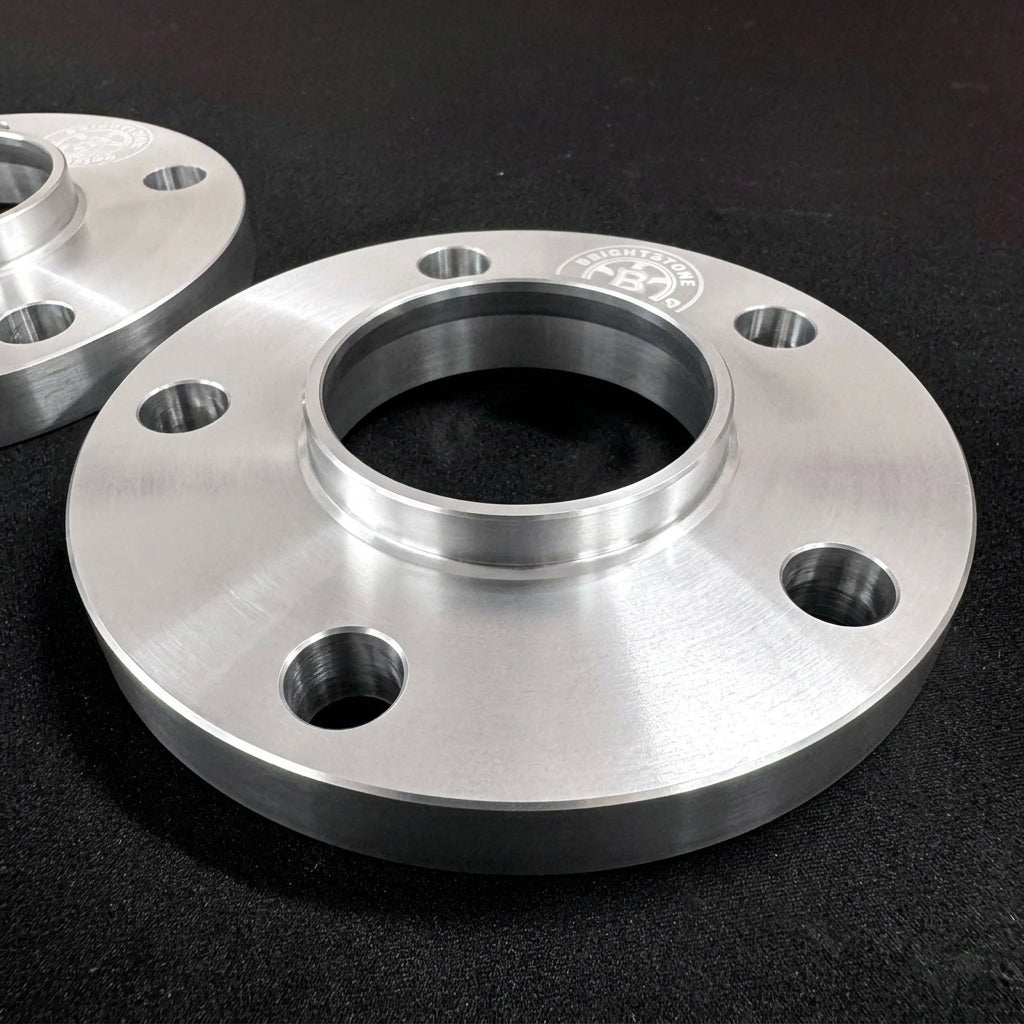
2× hubcentric wheel spacers — bored to 57.1mm, in your chosen thickness
10× extended wheel bolts — M14×1.5 ball-seat, with the threaded part extended by your wheel spacer's thickness. We make every effort to send the correct bolts, but you must check them against the bolts on your car before fitting — thread, seat and threaded length. See bolt checks below. If your car uses wheel nuts and studs (not bolts), this kit will not work for you. Get in touch to see if we can help.
Check your bolts before fitting
We make every effort to send the correct bolts for your vehicle, but vehicles vary by model year, market, trim and previous modifications — we can’t see what is fitted to your car. It is the responsibility of the buyer and whoever fits these parts to check every bolt against the car before use. Do not fit any bolt you have not checked, even if it came from us.
Before we dispatch: Once the order has been placed, we will email to confirm the model, make and year of the car to ensure that the bolts are correct before dispatch.
- Measure a bolt from your car.Remove one of your existing wheel bolts and measure its thread length, thread size and pitch, and check its seat type (the shape under the head — see step 2). Measure the threaded part only — from where the thread starts to the tip, not including the head. The threaded part of the new bolt must be longer than this by the thickness of the spacer you’ve bought: for example, a bolt with 28mm of thread used with a 20mm spacer needs a bolt with 48mm of thread.
- Compare it with the bolts you’ll fit — including ours.Thread size, pitch, seat type and head must match your original bolt exactly. What is the seat? It’s the shape of the underside of the bolt head — the part that presses against your wheel. It’s usually either cone-shaped (called “conical” or “60° taper”) or rounded (called “ball” or “radius”). It must match the shape of the bolt holes in your wheel: the wrong shape only touches the wheel on a thin edge and can work loose. Simple check: hold your old bolt next to the new one — the underside of the heads should be the same shape.
- Check the extra length matches your spacer.The threaded part of the new bolt must be longer than the threaded part of your original by the thickness of the spacer you’ve bought — for example, a 20mm spacer needs a bolt 20mm longer. If you’ve bought different thicknesses for front and rear, keep each bolt set with its own spacers.
- Confirm full thread engagement.Once fitted, each bolt must engage the hub by at least as much thread as your original bolt did without a spacer — never less — without bottoming out or fouling anything behind the hub. What is thread engagement? It’s how much of the bolt’s thread is actually screwed into the hub — this is what holds your wheel on. Simple check: when you take out an original bolt, count how many full turns it takes to come out once it’s loose. After fitting, each new bolt must take at least that many full turns to screw in by hand before its head reaches the wheel. Fewer turns means less thread holding the wheel on — do not drive the car. If a bolt stops turning before its head reaches the wheel, it may be too long or cross-threaded — don’t force it. Once every bolt is in, tighten them to your vehicle manufacturer’s specified torque setting using a torque wrench — check your owner’s handbook or a main dealer for the correct figure for your car.
- If anything doesn’t match, don’t fit it.Contact us with photos and measurements before fitting and we’ll sort it out.
Fitting should be done by a competent person or a professional garage. Re-check all bolts after the first 50–100 miles. Brightstone Engineering cannot accept responsibility for problems caused by fitting bolts that have not been checked against the vehicle as described above.
Product Description:
Precision CNC-machined Bentley wheel spacers for the Continental GT, Continental GTC and Flying Spur. Engineered in the UK from aerospace-grade 6082-T6 billet aluminium to the exact 5×112 (5x112) PCD and 57.1mm centre bore specification — delivering a measurably wider stance, corrected wheel offset, and a transformed presence that complements Bentley's grand touring character without compromise to refinement or safety.
Every pair is bored to exactly 57.1mm to engage the hub register precisely, eliminating vibration at source. Supplied with extended M14×1.5 ball-seat wheel bolts matched to Bentley's OEM fastener specification.
Available in 15mm and 20mm. Need a specific thickness? Contact us.
Fitment
| Model | Body | Engine | Years |
|---|---|---|---|
| Bentley Continental GT — Mk1 (2003–2011) · 5×112 PCD · 57.1mm Centre Bore | |||
| Continental GT | Coupé | 6.0L W12 Twin-Turbo — 552–567 hp | 2003–2011 |
| Continental GTC | Convertible | 6.0L W12 Twin-Turbo — 552 hp | 2006–2011 |
| Continental GT Speed | Coupé | 6.0L W12 Twin-Turbo — 600 hp | 2007–2011 |
| Continental GTC Speed | Convertible | 6.0L W12 Twin-Turbo — 600 hp | 2009–2011 |
| Continental Supersports | Coupé | 6.0L W12 Twin-Turbo — 621 hp | 2009–2011 |
| Continental Supersports Convertible | Convertible | 6.0L W12 Twin-Turbo — 621 hp | 2011–2011 |
| Bentley Continental GT — Mk2 (2011–2018) · 5×112 PCD · 57.1mm Centre Bore | |||
| Continental GT W12 | Coupé | 6.0L W12 Twin-Turbo — 567–582 hp | 2011–2018 |
| Continental GTC W12 | Convertible | 6.0L W12 Twin-Turbo — 567 hp | 2011–2018 |
| Continental GT V8 | Coupé | 4.0L V8 Twin-Turbo — 500 hp | 2012–2018 |
| Continental GTC V8 | Convertible | 4.0L V8 Twin-Turbo — 500 hp | 2012–2018 |
| Continental GT V8 S | Coupé | 4.0L V8 Twin-Turbo — 521 hp | 2013–2018 |
| Continental GTC V8 S | Convertible | 4.0L V8 Twin-Turbo — 521 hp | 2013–2018 |
| Continental GT Speed W12 | Coupé | 6.0L W12 Twin-Turbo — 626 hp | 2014–2018 |
| Continental GT Speed Convertible | Convertible | 6.0L W12 Twin-Turbo — 626 hp | 2014–2018 |
| Continental GT3-R | Coupé | 4.0L V8 Twin-Turbo — 572 hp | 2014–2015 |
| Continental GT Supersports | Coupé & Convertible | 6.0L W12 Twin-Turbo — 710 hp | 2017–2018 |
| Bentley Flying Spur — 1st Generation (2005–2013) · 5×112 PCD · 57.1mm Centre Bore | |||
| Continental Flying Spur | Saloon | 6.0L W12 Twin-Turbo — 552 hp | 2005–2013 |
| Continental Flying Spur Speed | Saloon | 6.0L W12 Twin-Turbo — 600 hp | 2007–2013 |
| Bentley Flying Spur — 2nd Generation (2013–2019) · 5×112 PCD · 57.1mm Centre Bore | |||
| Flying Spur W12 | Saloon | 6.0L W12 Twin-Turbo — 616 hp | 2013–2019 |
| Flying Spur V8 | Saloon | 4.0L V8 Twin-Turbo — 500 hp | 2014–2019 |
| Flying Spur V8 S | Saloon | 4.0L V8 Twin-Turbo — 521 hp | 2016–2019 |
| Flying Spur W12 S | Saloon | 6.0L W12 Twin-Turbo — 626 hp | 2016–2019 |
| ⚠ Mk3 Continental GT (2018+) and Flying Spur (2020+) use 5×130 PCD — not compatible with this kit. Contact us to discuss fitment for those models. | |||
All models above use 5×112 PCD, 57.1mm centre bore and M14×1.5 ball-seat wheel bolts. Always confirm your vehicle's exact PCD and hub bore before ordering.
Not compatible with Mk3 Continental GT (2018+), Flying Spur (2020+) or Bentley Bentayga — these models use different bolt patterns. Contact us to discuss fitment options.
These Bentley 5×112 (5x112) wheel spacers are designed specifically for Continental GT and Flying Spur models built on the VW Group D platform, with 5×112 PCD (pitch circle diameter) wheel bolt pattern and 57.1mm hub bore (centre bore). Continental GT wheel spacers, Continental GTC wheel spacers and Flying Spur wheel spacers are all covered by this kit — spanning Bentley's full grand tourer and saloon range built at Crewe, including W12, V8, GT Speed, GT Supersports and GT3-R variants.
Important generation note: This page covers the Continental GT Mk1 (2003–2011) and Mk2 (2011–2018), and the Flying Spur first and second generation (2005–2019). The Mk3 Continental GT (2018+) and Continental GTC (2019+) moved to a 5×130 bolt pattern — contact us to discuss fitment for those models.
The Bentley Bentayga also uses a different bolt pattern and is not covered by this kit — contact us for Bentayga fitment.
Check your PCD and centre bore before ordering.
If you're unsure, contact us and we'll confirm the correct fitment before you order.
Installation:
Professional fitting recommended. Before fitting, you must check the bolts against your car.
- Measure a bolt from your car. Remove one of your existing wheel bolts and measure it. Measure the threaded part only — from where the thread starts to the tip, not including the head. The threaded part of the new bolt must be longer than this by the thickness of the spacer you've bought: for example, a bolt with 28mm of thread used with a 20mm spacer needs a bolt with 48mm of thread.
-
Compare it with the bolts you'll be fitting — whether supplied by us or sourced yourself. Thread size, pitch, seat type and head must match your original.
What is the seat? It's the shape of the underside of the bolt head — the part that presses against your wheel. It's usually either cone-shaped (called "conical" or "60° taper") or rounded (called "ball" or "radius"). It must match the shape of the bolt holes in your wheel: the wrong shape only touches the wheel on a thin edge and can work loose. Simple check: hold your old bolt next to the new one — the underside of the heads should be the same shape. - Check the extra length. The threaded part of the new bolt must be longer than the threaded part of your original by the thickness of the spacer you've bought.
-
Confirm thread engagement. Once fitted, every bolt must engage the hub by at least as much thread as your original bolt did without a spacer — never less.
What is thread engagement? It's how much of the bolt's thread is actually screwed into the hub — this is what holds your wheel on. The spacer moves the wheel further out, which is why the bolt needs to be longer. Simple check: when you take out an original bolt, count how many full turns it takes to come out once it's loose. After fitting the spacer and wheel, each new bolt must take at least that many full turns to screw in by hand before its head reaches the wheel. Fewer turns means less thread holding the wheel on — do not drive the car. If a bolt stops turning before its head reaches the wheel, it may be too long or cross-threaded — don't force it. Once every bolt is in, tighten them to your vehicle manufacturer's specified torque setting using a torque wrench — check your owner's handbook or a main dealer for the correct figure for your car. - If anything doesn't match, do not fit them — contact us first.
We make every effort to send the correct bolts, but it is the buyer's and installer's responsibility to verify them before use.
Re-check all wheel bolts after the first 50–100 miles.
Shipping & Warranty
- Free UK delivery on all orders
- International shipping available
- Lifetime guarantee on all Brightstone spacers
Frequently Asked Questions
Are wheel spacers safe on a Bentley Continental GT?
Yes, provided they are hubcentric, correctly specified, and fitted with bolts you have checked against your originals and that achieve full thread engagement. A hubcentric spacer engages the hub register directly — the hub carries the load, not the wheel bolts. Our spacers are machined to OEM tolerances and supplied with correctly rated M14×1.5 ball-seat hardware for the application.
Will wheel spacers void my Bentley warranty?
Most Continental GT and Flying Spur models on this page are now outside their original warranty period. Fitting aftermarket components can affect warranty coverage on modified parts, but does not automatically void your entire vehicle warranty under UK consumer law. We recommend retaining installation records regardless.
What size wheel spacers should I fit to my Bentley Continental GT?
15mm is the most popular choice — it delivers a meaningful track width increase and a more planted, authoritative stance without altering the car's proportions noticeably. 20mm produces a more pronounced flush fitment and works particularly well on GT Speed and Supersports models which carry a more aggressive factory appearance.
What size wheel spacers should I fit to my Bentley Flying Spur?
15mm works well on both generations of Flying Spur, adding presence and correcting wheel offset without affecting the car's grand touring composure. 20mm suits owners wanting a more pronounced change, particularly on the second-generation Flying Spur which has a more sporting stance from factory.
Do I need to check the bolts before fitting?
Yes — and this is the buyer's and installer's responsibility. We make every effort to send the correct bolts, but vehicles vary by model year, market and previous modifications, so before fitting you must remove one of the bolts currently on your car, measure it, and confirm the bolts you'll fit match it for thread size, pitch, seat type and head, and have a threaded part longer than your original's by exactly the thickness of the spacer you've bought (measure the threaded part only, not the head). Once fitted, each bolt must engage the hub by at least as much thread as your original did without a spacer. Once fitted, tighten them to your vehicle manufacturer's specified torque setting. If anything doesn't match, don't fit them — contact us and we'll sort it out.
Do I need a wheel alignment after fitting wheel spacers?
Wheel spacers do not alter suspension or steering geometry directly. However if your car has been lowered or is near the limit of its alignment tolerances, adding track width can push it fractionally out. We recommend a check if the car has been modified.
What is the difference between hubcentric and lug-centric spacers?
A hubcentric spacer has a precision-machined bore matching your hub diameter exactly — 57.1mm in this case — so the hub centres the wheel and carries the lateral load. A lug-centric spacer relies on the wheel bolts to centre the wheel, which can cause vibration and places additional stress on the fasteners. All Brightstone spacers are hubcentric.
Will these fit my Bentley Bentayga or Mk3 Continental GT?
No. The Bentley Bentayga and Mk3 Continental GT (2018+) use a different bolt pattern and are not compatible with this kit. Contact us to discuss fitment options for those models.
Browse by marque
Porsche
Porsche hubcentric wheel spacers
5×130 · 71.6mm bore
View →BMW
BMW F-chassis wheel spacers
5×120 · 72.6mm bore
View →BMW
BMW G-chassis wheel spacers
5×112 · 66.6mm bore
View →Mercedes-Benz
Mercedes-Benz wheel spacers
5×112 · 66.5mm bore
View →Audi
Audi A4, A5, A6, Q5, Q7 wheel spacers
5×112 · 66.6mm bore
View →Audi
Audi A3, TT & R8 wheel spacers
5×112 · 57.1mm bore
View →Volkswagen
VW Golf, Passat & Tiguan wheel spacers
5×112 · 57.1mm bore
View →Alfa Romeo
Alfa Romeo Giulia, Stelvio & 159
5×110 · 65.1mm bore
View →Aston Martin
DB11, DB12 & DBX wheel spacers
5×128 · 75.1mm bore
View →Aston Martin
DB9, Rapide, Vantage & Virage wheel spacers
5×114.3 · 68.1mm bore
View →Ferrari
Ferrari hubcentric wheel spacers
5×114.3 · 67.1mm bore
View →Bentley
Continental GT & Flying Spur wheel spacers
5×112 · 57.1mm bore
View →Maserati
Ghibli, GranTurismo, Quattroporte & Levante
5×114.3 · 67.1mm bore
View →Lamborghini
Gallardo & Huracán wheel spacers
5×112 · 57.1mm / 66.5mm bore
View →Brightstone Engineering Bespoke
Discover our range of bespoke and custom items
